Terrain
Seelow Heights
1945: Seelower Höhen
- From the Reichstag
- 68.03 km
- Today
- Standing today
- Appears on
- 10 days
52.5328° N, 14.3814° E position approximate Open on the map →
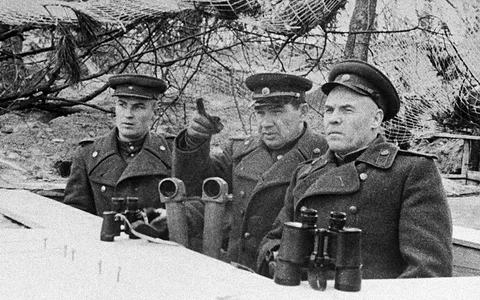
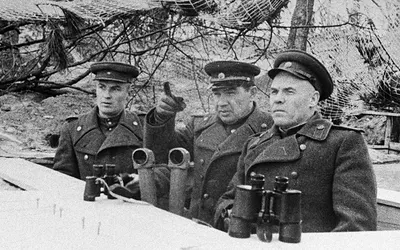
The Seelow Heights, a ridge some 48 metres high overlooking the Oder about 90 kilometres east of Berlin, were where the battle was largely decided before the Red Army reached the city (introduction). Rather than hold the open plain, Gotthard Heinrici of Army Group Vistula chose to fortify the heights, held by Theodor Busse's 9th Army. Three lines of trenches — the Hauptkampflinie, the Hardenberg-Stellung and the Wotan-Stellung — ran for 16–24 kilometres, with bunkers and anti-tank ditches.
16 April
The offensive of Georgy Zhukov's 1st Belorussian Front opened in the dark on 16 April with a barrage of some 9,000 guns firing 500,000 shells in 30 minutes. Heinrici had expected it and pulled most of his men back to the second line before it began. Searchlights meant to light the way for the infantry instead silhouetted them as they crossed the swampy floodplain. Zhukov had promised Stalin the heights within the day; by evening his troops had reached only the first line, with heavy losses, and his decision to send in the tank armies after midday jammed the roads from the bridgeheads. Shortly before midnight Soviet tanks took the first three houses in the town of Seelow.
17–19 April
On 17 April the attackers struggled through minefields and across the flooded plain to the far more heavily manned Hardenberg line. Vasily Chuikov's 8th Guards Army reached the heights by noon, and by nightfall the 5th Shock Army and the 2nd Guards Tank Army had broken through the second line. The account dates the taking of the heights to around 7pm that day (18 April); the page for 19 April speaks of them being overrun on the 18th.
Beyond the heights lay the Wotan line west of Müncheberg. On 18 April Soviet columns jammed on the forest roads and lost heavy armour to German anti-tank squads. The last line broke on 19 April, and a substantial part of the 9th Army was encircled before it could fall back on Berlin. By the account's figures, the 1st Belorussian Front lost nearly three times as many men as the defenders. From there the way to Berlin lay through open country.
Visit
The heights are kept today as a memorial, with a museum and a military cemetery. Berlin Experiences describes visiting the Seelow Heights Memorial today.
In the day-by-day account
- — Introduction The Battle of Berlin 1945: Introduction
- 01 Monday, 16 April 1945 The Soviet Offensive Begins
- 02 Tuesday, 17 April 1945 Zhukov Struggles To Break Out
- 03 Wednesday, 18 April 1945 Zhukov & Konev Advance
- 04 Thursday, 19 April 1945 Through The ‘Gates Of Berlin’
- 06 Saturday, 21 April 1945 Red Army Troops Reach Berlin
- 07 Sunday, 22 April 1945 The Red Army Grinds Into Berlin’s Suburbs
- 08 Monday, 23 April 1945 Stalin Changes The Plan
- 09 Tuesday, 24 April 1945 The Red Army Reaches The S-Bahn Ring
- 17 Wednesday, 2 May 1945 The End Of Nazi Berlin
In the acquired archive 2
2 items are catalogued under this name — 2 named in the item's own title, the rest carried as an index term by the institution that holds them. A name in a catalogue is not a statement about what a photograph shows.